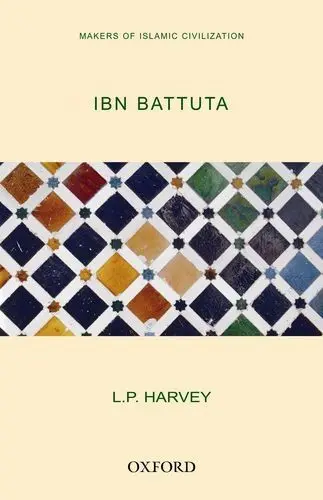
Ibn Battuta (Makers of Islamic Civilisation)
About The Book
Ibn Battuta (d. ca. 700/1368 or 9) was famed in his own lifetime as the greatest
After an overview of Ibn Battuta's journeys and how the Travels became a book, Pat Harvey picks out major themes for closer analysis—how Ibn Battuta's adventures were financed, how geography and natural history are presented, issues of race and gender as addressed in the book, and the religious framework through which Ibn Battuta moved. From Harvey's account of the
L. P. Harvey, formerly Cervantes Professor of Spanish at King's College, University of London, and Fellow of the Oxford Centre for Islamic Studies, is the author of Islamic Spain 1250 to 1500 (1990) and Muslims in Spain 1500 to 1614 (2005).
About The Author
L. P. Harvey, formerly Cervantes Professor of Spanish at King's College, University of London, and Fellow of the Oxford Centre for Islamic Studies, is the author of Islamic Spain 1250 to 1500 (1990) and Muslims in Spain 1500 to 1614 (2005).
Original: $14.00
-65%$14.00
$4.90Ibn Battuta (Makers of Islamic Civilisation)
About The Book
Ibn Battuta (d. ca. 700/1368 or 9) was famed in his own lifetime as the greatest
After an overview of Ibn Battuta's journeys and how the Travels became a book, Pat Harvey picks out major themes for closer analysis—how Ibn Battuta's adventures were financed, how geography and natural history are presented, issues of race and gender as addressed in the book, and the religious framework through which Ibn Battuta moved. From Harvey's account of the
L. P. Harvey, formerly Cervantes Professor of Spanish at King's College, University of London, and Fellow of the Oxford Centre for Islamic Studies, is the author of Islamic Spain 1250 to 1500 (1990) and Muslims in Spain 1500 to 1614 (2005).
About The Author
L. P. Harvey, formerly Cervantes Professor of Spanish at King's College, University of London, and Fellow of the Oxford Centre for Islamic Studies, is the author of Islamic Spain 1250 to 1500 (1990) and Muslims in Spain 1500 to 1614 (2005).
Product Information
Product Information
Shipping & Returns
Shipping & Returns
Description
About The Book
Ibn Battuta (d. ca. 700/1368 or 9) was famed in his own lifetime as the greatest
After an overview of Ibn Battuta's journeys and how the Travels became a book, Pat Harvey picks out major themes for closer analysis—how Ibn Battuta's adventures were financed, how geography and natural history are presented, issues of race and gender as addressed in the book, and the religious framework through which Ibn Battuta moved. From Harvey's account of the
L. P. Harvey, formerly Cervantes Professor of Spanish at King's College, University of London, and Fellow of the Oxford Centre for Islamic Studies, is the author of Islamic Spain 1250 to 1500 (1990) and Muslims in Spain 1500 to 1614 (2005).
About The Author
L. P. Harvey, formerly Cervantes Professor of Spanish at King's College, University of London, and Fellow of the Oxford Centre for Islamic Studies, is the author of Islamic Spain 1250 to 1500 (1990) and Muslims in Spain 1500 to 1614 (2005).