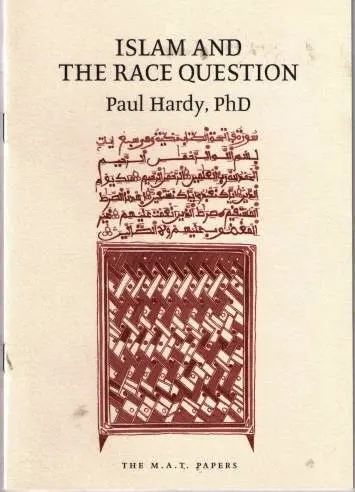
Islam and the Race Question : Paul Hardy PhD
About the Book
The racialized discourse prevalent in our own era has over the centuries proven alien to the societies which developed under the inspiration of Islam. Even more alien to those societies has been the tendency found in the West to articulate personal identity almost entirely in racial terms.
For in racialized nations like the United States, Europe, South Africa, or the Caribbean, appearance or physical attributes, such as hair, skin, and bone structure, have been more consequential, more starkly invested with social significance, than anything else such as family, wealth culture education or personal achievement.
It goes without saying that this investing of bodily marks with so high a degree of significance is sociogenic in origin and not phylogenic. To think otherwise would be to place racism beyond the possibility of eradication.
It is a historical accident, not a necessity of nature that produces racist perceptions, actions, and discourse. Some historians say that the concept of race did not enter European consciousness until the fifteenth century. But certainly, by the midpoint of the nineteenth century, Benjamin Disraeli could declare that “all is race.”
That is, the basic human condition—and thus economic, political, scientific, and cultural positions—are taken to be determined by race. So by the twentieth century, Cromer and Balfour, the most highly-esteemed of British colonial administrators, took it as a matter of course that Europeans and the English, in particular, were the master race. All others were “subject races.”
About Author:
Paul Hardy is a contemporary Islamic scholar, educated in England and in the United States, who devotes himself to the Muslim-Christian dialogue. He acquired B. A. and M. A. at Oxford and his Ph.D. is in Islamic thought (Islamic Thought ) at the University of Chicago.
He taught at the School of Oriental and African Studies at the University of London and the City College of New York (Hunter College) in New York. His work focuses on Islamic extremism form and Islamic philosophy. In 2008 he was one of the Muslim delegation participants of the 2nd Seminar of the Catholic-Muslim Forum.
Islam and the Race Question : Paul Hardy PhD
About the Book
The racialized discourse prevalent in our own era has over the centuries proven alien to the societies which developed under the inspiration of Islam. Even more alien to those societies has been the tendency found in the West to articulate personal identity almost entirely in racial terms.
For in racialized nations like the United States, Europe, South Africa, or the Caribbean, appearance or physical attributes, such as hair, skin, and bone structure, have been more consequential, more starkly invested with social significance, than anything else such as family, wealth culture education or personal achievement.
It goes without saying that this investing of bodily marks with so high a degree of significance is sociogenic in origin and not phylogenic. To think otherwise would be to place racism beyond the possibility of eradication.
It is a historical accident, not a necessity of nature that produces racist perceptions, actions, and discourse. Some historians say that the concept of race did not enter European consciousness until the fifteenth century. But certainly, by the midpoint of the nineteenth century, Benjamin Disraeli could declare that “all is race.”
That is, the basic human condition—and thus economic, political, scientific, and cultural positions—are taken to be determined by race. So by the twentieth century, Cromer and Balfour, the most highly-esteemed of British colonial administrators, took it as a matter of course that Europeans and the English, in particular, were the master race. All others were “subject races.”
About Author:
Paul Hardy is a contemporary Islamic scholar, educated in England and in the United States, who devotes himself to the Muslim-Christian dialogue. He acquired B. A. and M. A. at Oxford and his Ph.D. is in Islamic thought (Islamic Thought ) at the University of Chicago.
He taught at the School of Oriental and African Studies at the University of London and the City College of New York (Hunter College) in New York. His work focuses on Islamic extremism form and Islamic philosophy. In 2008 he was one of the Muslim delegation participants of the 2nd Seminar of the Catholic-Muslim Forum.
Product Information
Product Information
Shipping & Returns
Shipping & Returns
Description
About the Book
The racialized discourse prevalent in our own era has over the centuries proven alien to the societies which developed under the inspiration of Islam. Even more alien to those societies has been the tendency found in the West to articulate personal identity almost entirely in racial terms.
For in racialized nations like the United States, Europe, South Africa, or the Caribbean, appearance or physical attributes, such as hair, skin, and bone structure, have been more consequential, more starkly invested with social significance, than anything else such as family, wealth culture education or personal achievement.
It goes without saying that this investing of bodily marks with so high a degree of significance is sociogenic in origin and not phylogenic. To think otherwise would be to place racism beyond the possibility of eradication.
It is a historical accident, not a necessity of nature that produces racist perceptions, actions, and discourse. Some historians say that the concept of race did not enter European consciousness until the fifteenth century. But certainly, by the midpoint of the nineteenth century, Benjamin Disraeli could declare that “all is race.”
That is, the basic human condition—and thus economic, political, scientific, and cultural positions—are taken to be determined by race. So by the twentieth century, Cromer and Balfour, the most highly-esteemed of British colonial administrators, took it as a matter of course that Europeans and the English, in particular, were the master race. All others were “subject races.”
About Author:
Paul Hardy is a contemporary Islamic scholar, educated in England and in the United States, who devotes himself to the Muslim-Christian dialogue. He acquired B. A. and M. A. at Oxford and his Ph.D. is in Islamic thought (Islamic Thought ) at the University of Chicago.
He taught at the School of Oriental and African Studies at the University of London and the City College of New York (Hunter College) in New York. His work focuses on Islamic extremism form and Islamic philosophy. In 2008 he was one of the Muslim delegation participants of the 2nd Seminar of the Catholic-Muslim Forum.