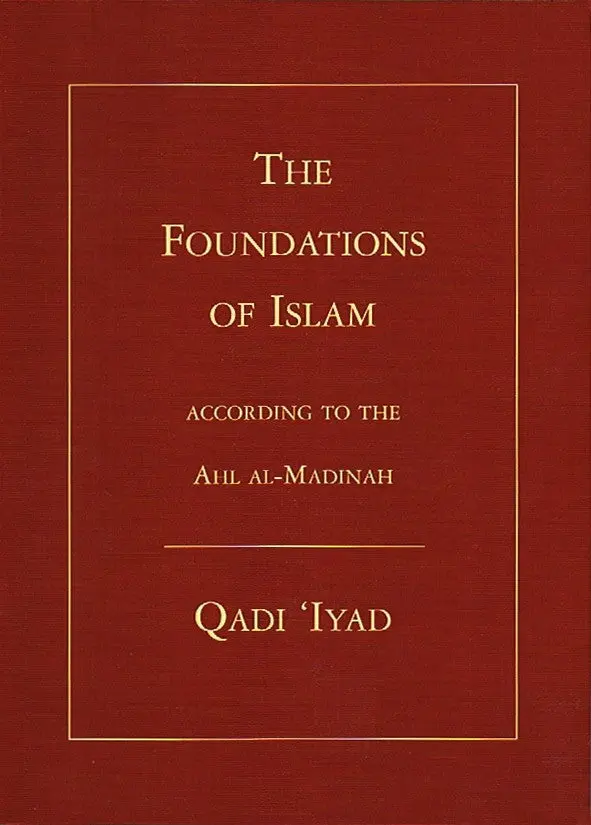
The Foundations of Islam According To The Ahl Al-Madinah
About The Book
This book is a clear-cut manual laid out in five sections corresponding to the five pillars, and marked out with the simplicity of a basic technical manual. For each pillar the fard, sunna, supererogatory, liked, disliked and prohibited are concisely listed, with special page markings for easy reference and study. This book is useful for new Muslims but also for refreshing the knowledge of the basics of even the most learned scholars.
About The Author
Qadi Iyad ibn Musa (1083–1149) born in Ceuta, then belonging to the Almoravid Empire, was the great imam of that city and, later, a high judge (qadi) in Granada. Qadi Iyaḍ was born into an established family of Arab origin in Ceuta. As a scion of a notable scholarly family, ʿIyad was able to learn from the best teachers Ceuta had to offer.
The judge Abu ʿAbd Allah Muhammad b. ʿIsa (d. 505/1111) was ʿIyad’s first important teacher and is credited with his basic academic formation. Growing up, ʿIyad benefited from the traffic of scholars from al-Andalus, the Maghrib, and the eastern Islamic world. He became a prestigious scholar in his own right and won the support of the highest levels of society.
He was one of the most famous scholars of Maliki law and author of the well-known Ash-Shifa on the virtues of the prophet and Tartib al-mardarik wa-taqrib al-masalik li-marifat alam madhab Malik, a collection of biographies of eminent Malikis, a.o. Abu Bakr ibn al-Arabi.
Original: $20.00
-65%$20.00
$7.00The Foundations of Islam According To The Ahl Al-Madinah
About The Book
This book is a clear-cut manual laid out in five sections corresponding to the five pillars, and marked out with the simplicity of a basic technical manual. For each pillar the fard, sunna, supererogatory, liked, disliked and prohibited are concisely listed, with special page markings for easy reference and study. This book is useful for new Muslims but also for refreshing the knowledge of the basics of even the most learned scholars.
About The Author
Qadi Iyad ibn Musa (1083–1149) born in Ceuta, then belonging to the Almoravid Empire, was the great imam of that city and, later, a high judge (qadi) in Granada. Qadi Iyaḍ was born into an established family of Arab origin in Ceuta. As a scion of a notable scholarly family, ʿIyad was able to learn from the best teachers Ceuta had to offer.
The judge Abu ʿAbd Allah Muhammad b. ʿIsa (d. 505/1111) was ʿIyad’s first important teacher and is credited with his basic academic formation. Growing up, ʿIyad benefited from the traffic of scholars from al-Andalus, the Maghrib, and the eastern Islamic world. He became a prestigious scholar in his own right and won the support of the highest levels of society.
He was one of the most famous scholars of Maliki law and author of the well-known Ash-Shifa on the virtues of the prophet and Tartib al-mardarik wa-taqrib al-masalik li-marifat alam madhab Malik, a collection of biographies of eminent Malikis, a.o. Abu Bakr ibn al-Arabi.
Product Information
Product Information
Shipping & Returns
Shipping & Returns
Description
About The Book
This book is a clear-cut manual laid out in five sections corresponding to the five pillars, and marked out with the simplicity of a basic technical manual. For each pillar the fard, sunna, supererogatory, liked, disliked and prohibited are concisely listed, with special page markings for easy reference and study. This book is useful for new Muslims but also for refreshing the knowledge of the basics of even the most learned scholars.
About The Author
Qadi Iyad ibn Musa (1083–1149) born in Ceuta, then belonging to the Almoravid Empire, was the great imam of that city and, later, a high judge (qadi) in Granada. Qadi Iyaḍ was born into an established family of Arab origin in Ceuta. As a scion of a notable scholarly family, ʿIyad was able to learn from the best teachers Ceuta had to offer.
The judge Abu ʿAbd Allah Muhammad b. ʿIsa (d. 505/1111) was ʿIyad’s first important teacher and is credited with his basic academic formation. Growing up, ʿIyad benefited from the traffic of scholars from al-Andalus, the Maghrib, and the eastern Islamic world. He became a prestigious scholar in his own right and won the support of the highest levels of society.
He was one of the most famous scholars of Maliki law and author of the well-known Ash-Shifa on the virtues of the prophet and Tartib al-mardarik wa-taqrib al-masalik li-marifat alam madhab Malik, a collection of biographies of eminent Malikis, a.o. Abu Bakr ibn al-Arabi.