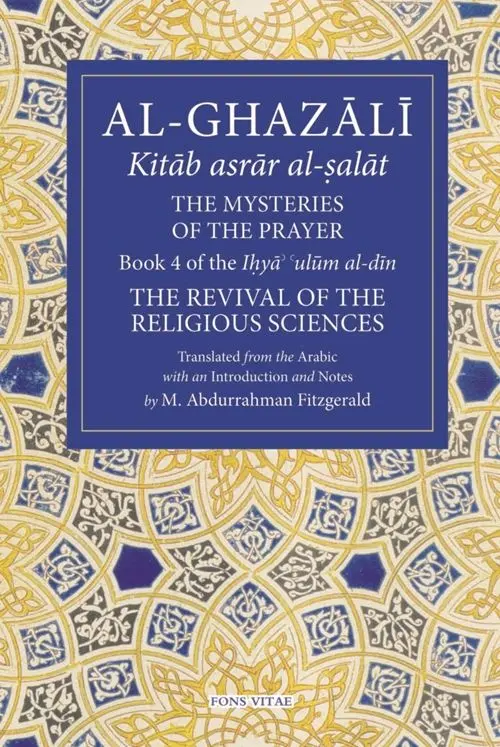
The mysteries of the prayer - Book 4 of the Ihya Ulum al-Din
About The Book
In the Mysteries of the Prayer and Its Important Elements (Kitāb asrār al-ṣalāt wa-muhimātiha), book 4 of the forty books of the Revival of the Religious Sciences (Iḥyāʾ ʿulūm al-dīn), Abū Ḥāmid al-Ghazālī explains the inner and outer meanings of the prayer, a central practice for Muslims. This is one of five books that deal with the inner dimensions of Islamic worship; books 3, 5, 6, and 7 address purification, zakāt, fasting, and pilgrimage, respectively.
Al-Ghazālī begins with a discussion of the merits of the prayer, the prostration, the importance of reverence, and the mosque. He explains the acts involved in the outward elements of the prayer and outlines which of these acts are obligatory and which are sunna. He then discusses the inward requisites of the prayer—the practices of the heart— and presents practical remedies for a distracted heart.
Al-Ghazālī explains the role of the imām who leads the group prayer and the merits of the Friday prayer; he addresses supererogatory prayers, the daily sunnas, and the weekly prayers, including recommendations for each day of the week, and for each night. Al-Ghazālī discusses the annual prayers (the two ʿīds and the tarāwīḥ prayers during Ramaḍān), and finally, the prayers and supplications related to events such as eclipses, the prayer for rain, guidance, and need.
This readable yet comprehensive work covers an array of issues from the essential outward aspects of how to pray, to the inward aspects of the state of the heart during the prayer and how to humble oneself completely. As a practical, yet profound book, it is essential reading for Muslims who seek a deeper comprehension of prayer, and for all those interested in understanding the meaning and place of prayer in Islam.
About The Author
Imam Abu Hamid Muhammad Al-Ghazali was born in 450 AH (1058 A.D) in the Iranian town of Tus, studied Islamic law and theology at the Seljuq College in Nishapur, and became a distinguished professor at the famous Nizamiyya University in Baghdad.
Despite his glittering success, he was inwardly dissatisfied, so he abandoned his career for the life of hardship, abstinence and devotion to worship. During ten years of wandering, he experienced a spiritual transformation, in which the Truth came to him at last, as something received rather than acquired.
Blessed with an inner certainty, he then applied his outstanding faculties and vast learning to the task of revitalizing the whole Islamic tradition. Through his direct personal contacts, and through his many writings, he showed how every element in that tradition could and should be turned to its true purpose.
Imam al-Ghazzali was fondly referred to as the "Hujjat-ul-lslam", Proof of Islam, he is honoured as a scholar and a saint by learned men all over the world and is generally acclaimed as the most influential thinker of the Classical period of Islam.
He passed away in 505 AH (1111 A.D).
About The Translator
M. Abdurrahman Fitzgerald is the director of the Center for Language and Culture, Marrakesh. He has been involved in education and the study of Arabic, Islam, and Sufism for the past thirty years.
He co-translated Ibn al-Qayyim on the Invocation of God worked on the editing and annotation of Denys Johnson-Davies’s translation of al-Ghazali’s Kitab adab al-akl, and on Dr. Kenneth Honerkamp’s edition of al-Rasa’il al-kubra by Ibn ‘Abbad.
Original: $26.95
-65%$26.95
$9.43The mysteries of the prayer - Book 4 of the Ihya Ulum al-Din
About The Book
In the Mysteries of the Prayer and Its Important Elements (Kitāb asrār al-ṣalāt wa-muhimātiha), book 4 of the forty books of the Revival of the Religious Sciences (Iḥyāʾ ʿulūm al-dīn), Abū Ḥāmid al-Ghazālī explains the inner and outer meanings of the prayer, a central practice for Muslims. This is one of five books that deal with the inner dimensions of Islamic worship; books 3, 5, 6, and 7 address purification, zakāt, fasting, and pilgrimage, respectively.
Al-Ghazālī begins with a discussion of the merits of the prayer, the prostration, the importance of reverence, and the mosque. He explains the acts involved in the outward elements of the prayer and outlines which of these acts are obligatory and which are sunna. He then discusses the inward requisites of the prayer—the practices of the heart— and presents practical remedies for a distracted heart.
Al-Ghazālī explains the role of the imām who leads the group prayer and the merits of the Friday prayer; he addresses supererogatory prayers, the daily sunnas, and the weekly prayers, including recommendations for each day of the week, and for each night. Al-Ghazālī discusses the annual prayers (the two ʿīds and the tarāwīḥ prayers during Ramaḍān), and finally, the prayers and supplications related to events such as eclipses, the prayer for rain, guidance, and need.
This readable yet comprehensive work covers an array of issues from the essential outward aspects of how to pray, to the inward aspects of the state of the heart during the prayer and how to humble oneself completely. As a practical, yet profound book, it is essential reading for Muslims who seek a deeper comprehension of prayer, and for all those interested in understanding the meaning and place of prayer in Islam.
About The Author
Imam Abu Hamid Muhammad Al-Ghazali was born in 450 AH (1058 A.D) in the Iranian town of Tus, studied Islamic law and theology at the Seljuq College in Nishapur, and became a distinguished professor at the famous Nizamiyya University in Baghdad.
Despite his glittering success, he was inwardly dissatisfied, so he abandoned his career for the life of hardship, abstinence and devotion to worship. During ten years of wandering, he experienced a spiritual transformation, in which the Truth came to him at last, as something received rather than acquired.
Blessed with an inner certainty, he then applied his outstanding faculties and vast learning to the task of revitalizing the whole Islamic tradition. Through his direct personal contacts, and through his many writings, he showed how every element in that tradition could and should be turned to its true purpose.
Imam al-Ghazzali was fondly referred to as the "Hujjat-ul-lslam", Proof of Islam, he is honoured as a scholar and a saint by learned men all over the world and is generally acclaimed as the most influential thinker of the Classical period of Islam.
He passed away in 505 AH (1111 A.D).
About The Translator
M. Abdurrahman Fitzgerald is the director of the Center for Language and Culture, Marrakesh. He has been involved in education and the study of Arabic, Islam, and Sufism for the past thirty years.
He co-translated Ibn al-Qayyim on the Invocation of God worked on the editing and annotation of Denys Johnson-Davies’s translation of al-Ghazali’s Kitab adab al-akl, and on Dr. Kenneth Honerkamp’s edition of al-Rasa’il al-kubra by Ibn ‘Abbad.
Product Information
Product Information
Shipping & Returns
Shipping & Returns
Description
About The Book
In the Mysteries of the Prayer and Its Important Elements (Kitāb asrār al-ṣalāt wa-muhimātiha), book 4 of the forty books of the Revival of the Religious Sciences (Iḥyāʾ ʿulūm al-dīn), Abū Ḥāmid al-Ghazālī explains the inner and outer meanings of the prayer, a central practice for Muslims. This is one of five books that deal with the inner dimensions of Islamic worship; books 3, 5, 6, and 7 address purification, zakāt, fasting, and pilgrimage, respectively.
Al-Ghazālī begins with a discussion of the merits of the prayer, the prostration, the importance of reverence, and the mosque. He explains the acts involved in the outward elements of the prayer and outlines which of these acts are obligatory and which are sunna. He then discusses the inward requisites of the prayer—the practices of the heart— and presents practical remedies for a distracted heart.
Al-Ghazālī explains the role of the imām who leads the group prayer and the merits of the Friday prayer; he addresses supererogatory prayers, the daily sunnas, and the weekly prayers, including recommendations for each day of the week, and for each night. Al-Ghazālī discusses the annual prayers (the two ʿīds and the tarāwīḥ prayers during Ramaḍān), and finally, the prayers and supplications related to events such as eclipses, the prayer for rain, guidance, and need.
This readable yet comprehensive work covers an array of issues from the essential outward aspects of how to pray, to the inward aspects of the state of the heart during the prayer and how to humble oneself completely. As a practical, yet profound book, it is essential reading for Muslims who seek a deeper comprehension of prayer, and for all those interested in understanding the meaning and place of prayer in Islam.
About The Author
Imam Abu Hamid Muhammad Al-Ghazali was born in 450 AH (1058 A.D) in the Iranian town of Tus, studied Islamic law and theology at the Seljuq College in Nishapur, and became a distinguished professor at the famous Nizamiyya University in Baghdad.
Despite his glittering success, he was inwardly dissatisfied, so he abandoned his career for the life of hardship, abstinence and devotion to worship. During ten years of wandering, he experienced a spiritual transformation, in which the Truth came to him at last, as something received rather than acquired.
Blessed with an inner certainty, he then applied his outstanding faculties and vast learning to the task of revitalizing the whole Islamic tradition. Through his direct personal contacts, and through his many writings, he showed how every element in that tradition could and should be turned to its true purpose.
Imam al-Ghazzali was fondly referred to as the "Hujjat-ul-lslam", Proof of Islam, he is honoured as a scholar and a saint by learned men all over the world and is generally acclaimed as the most influential thinker of the Classical period of Islam.
He passed away in 505 AH (1111 A.D).
About The Translator
M. Abdurrahman Fitzgerald is the director of the Center for Language and Culture, Marrakesh. He has been involved in education and the study of Arabic, Islam, and Sufism for the past thirty years.
He co-translated Ibn al-Qayyim on the Invocation of God worked on the editing and annotation of Denys Johnson-Davies’s translation of al-Ghazali’s Kitab adab al-akl, and on Dr. Kenneth Honerkamp’s edition of al-Rasa’il al-kubra by Ibn ‘Abbad.